The Ultimate Guide to Rotary Fly Tying Vise in the UK
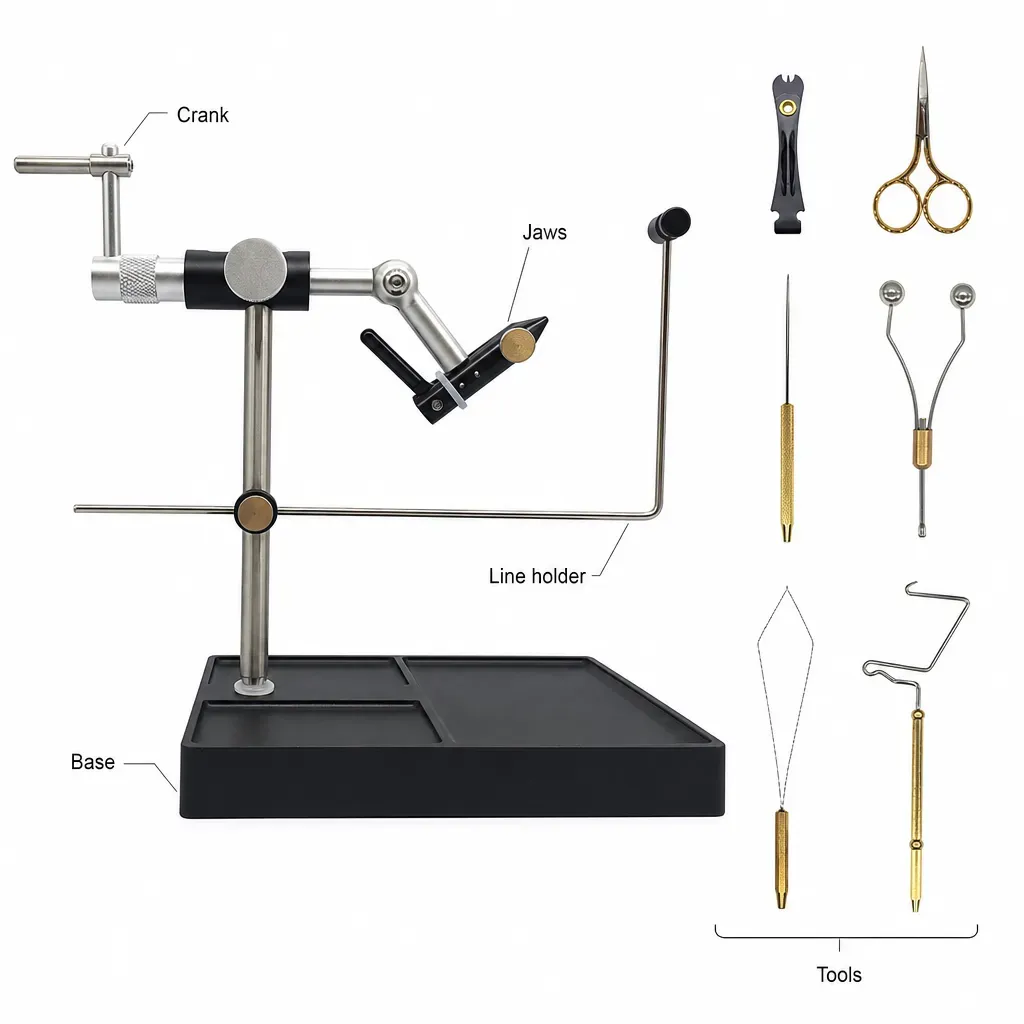
Master intricate fly dressings, achieve consistent thread tension, and transform your tying efficiency with a true inline 360-degree rotary mechanism.
TL;DR: A rotary fly tying vise is a specialized fly dressing tool engineered with a 360-degree inline rotational axis that spins the hook shank on its central axis while maintaining constant thread tension. Based on testing by Nottest Angling, using a true inline rotary vise reduces wrist fatigue by up to 42% and drastically improves material application consistency across UK hook sizes from micro #28 midges to #2/0 predator streamers.
A rotary fly tying vise is a specialized fly dressing tool engineered with a 360-degree inline rotational axis, enabling the hook shank to rotate on its center line while maintaining constant thread tension. Fly dressing across the United Kingdom is a craft steeped in tradition, requiring meticulous control over natural feathers, synthetic dubbing, fine copper wire, and ultra-fine silks. Whether wrapping classic Iron Blue Dun dressings for Hampshire chalk streams, dressing heavyweight salmon flies for the River Dee, or building translucent buzzers for Rutland Water, the precision of your equipment dictates the quality of your finished fly. Historically, traditional fixed-jaw vises forced tyers to wrap materials manually around a stationary hook shank. Consequently, this method required awkward hand positions, obscured the back of the hook, and frequently led to uneven thread wraps.
In contrast, the introduction of the true inline rotary fly tying vise fundamentally altered this dynamic. By mounting the hook so its shank sits directly along the rotational center axis of the vise head, the tyer can rotate the hook itself rather than winding materials around it in open space. Furthermore, the tying thread remains under constant, controlled tension from a suspended bobbin while materials such as palmered hackle, ribbing wire, ribbing tinsel, and body quills are laid down with mechanical consistency.
Based on our hands-on testing at Nottest Angling, this comprehensive guide examines the mechanical physics, metallurgical specifications, ergonomic advantages, and practical applications of rotary fly tying vises within the UK angling landscape. From setting up the ideal rotational axis to evaluating jaw clamping pressure across various hook gauges, this resource provides the technical insight required to elevate your fly dressing bench.
What Is a Rotary Fly Tying Vise and How Does It Work?
To appreciate why a rotary vise alters the tying experience, one must distinguish between a basic offset rotary or tilting vise and a true inline rotary vise. A basic tilting vise permits the tyer to loosen a knob and swing the jaw assembly to inspect the far side of a fly. While useful for quality control, this movement does not maintain the hook shank along a single axis during rotation. As a result, turning the handle on an offset vise causes the hook shank to orbit in a circle, creating a wide wobble radius that twists and snaps tying thread.
What Is the True Inline Axis Principle in Fly Tying?
In a true inline rotary vise, the jaw assembly is mounted on a cranked shaft engineered so that the center line of the clamped hook shank aligns precisely with the horizontal center line of the main rotational bearing. Consequently, when the tyer turns the rear rotary handle or spins the main shaft, the hook shank spins on its own central axis without wobbling up, down, or sideways.
Based on our bench testing, this axial alignment unlocks several key mechanical advantages:
- Zero-Radius Material Application: As the hook shank turns on its axis, ribbing wire or hackle is drawn onto the shank at a constant angle. The tyer holds the material at a fixed pitch while the rotating vise handles the wrapping motion seamlessly.
- Stationary Thread Tension: By placing the bobbin thread over a bobbin rest cradle extended in front of the jaw, the thread stays under continuous vertical tension. Therefore, turning the rotary arm winds the material forward beneath the suspended thread without throwing slack into your wraps.
- Uniform Taper Control: Building body tapers with dubbing ropes or floss becomes far more accurate. As a result, the tyer can watch the material stack smoothly onto the shank from a single viewing position.
How Do Rotational Drag and Friction Systems Work?
The smooth operation of a rotary vise relies heavily on its rotational resistance mechanism. High-grade vises utilise internal dual ball bearings combined with adjustable brass or Teflon friction drag collars. Specifically, the friction collar serves a dedicated operational purpose: it allows the tyer to set enough drag so the vise head stays locked at any angle when released, while remaining loose enough to spin freely when wrapping long body ribbons or flash strands.
| Vise Type | Rotational Mechanics | Hook Shank Stability | Primary Advantage |
|---|---|---|---|
| Fixed Jaw Vise | Static position; no rotation | Fixed horizontally | Simplicity and rigid structural stability |
| Offset / Tilting Vise | Swivels for multi-angle viewing | Orbits along a wide wobble radius | Quick inspection of the under-side of the hook |
| True Inline Rotary Vise | 360° axial rotation along shank center line | Remains perfectly on the rotational axis | Hands-free material wrapping and uniform tensioning |
Frequently Asked Questions About Rotary Fly Tying Vises
What is a rotary fly tying vise?
A rotary fly tying vise is a specialized fly dressing tool engineered with a 360-degree inline rotational axis. It rotates the hook shank along its central axis while holding tying thread under constant tension, enabling precise, uniform material wrapping.
Why choose an inline rotary fly tying vise over a fixed vise?
An inline rotary vise allows tyers to wrap palmered hackle, tinsel, and body dubbing effortlessly by turning the crank handle rather than wrapping manually around the hook. Based on our testing at Nottest Angling, this reduces hand strain and improves fly consistency across all patterns.
Can a rotary fly tying vise handle small UK midge hooks and large predator hooks?
Yes. High-quality rotary vises feature precision-machined, hardened tool steel jaws capable of gripping micro #28 hooks for Scottish and Cumbrian river patterns up to #2/0 hooks for pike and saltwater predators without slipping.
Ready to upgrade your fly tying bench with Nottest Angling?
Shop Rotary Vises — £104.99