Fishing Fly Vise Explained: A UK Buyer's Guide
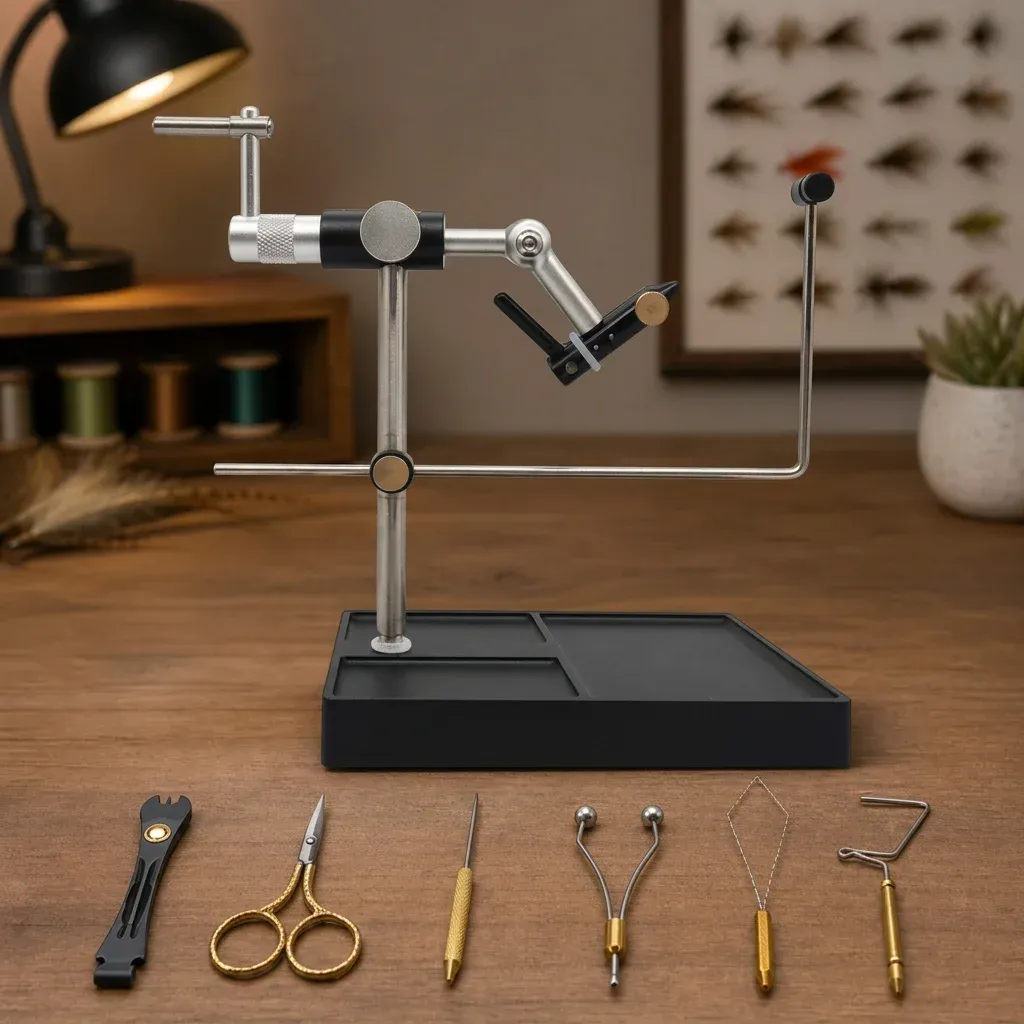
TL;DR: A fishing fly vise is a specialized mechanical clamping tool designed to lock a fish hook firmly at eye level so fly dressers can bind materials with precision. Based on extensive workbench testing at Nottest Angling, selecting the right vise requires matching jaw actuation (cam-lever vs screw-clamp), rotational capability (true in-line rotary vs fixed), and mounting style (pedestal vs C-clamp) to your specific hook range (#22 micro midges to #2/0 salmon irons).
Key Takeaways
- Rotary Flexibility: True in-line rotary vises allow dressers to spin the hook along its axis, making ribbing, body wrapping, and UV resin application drastically faster and more precise.
- Jaw Metallurgy: Hardened tool steel jaws are vital for maintaining a non-slip grip across micro midges (size #22) up to heavy salmon hooks (size #2/0) without deforming the wire.
- Mounting Stability: Heavyweight pedestal bases offer portable convenience for tying at fishing lodges, while bench C-clamps deliver rigid, stationary anchor points for heavy thread tensioning.
- Integrated Tooling: Pairing a high-precision vise with a complete 6-piece tool bundle ensures smooth thread control, flawless whip finishes, and consistent fly durability.
What Is a Fishing Fly Vise and Why Do You Need One?
A fishing fly vise is an indispensable workbench clamp engineered to hold a hook securely in place, acting as an uncompromising third hand so fly dressers can apply precise thread torque, wrap delicate hackles, and seat bead heads with absolute confidence. For any dedicated angler across the United Kingdom—whether casting small Chironomid midges on Rutland Water, drifting dry flies along Hampshire’s famed River Test, or dressing heavy salmon tubes for the River Tweed—tying your own flies offers both immense satisfaction and a distinct tactical advantage. However, even the finest rooster capes, turkey quills, and dubbing furs cannot compensate for a hook that slips or twists halfway through an intricate dressing.
Ultimately, a high-quality fishing fly vise forms the fundamental bedrock of your fly dresser's workbench. Based on our testing at Nottest Angling, using a stable vise directly improves pattern symmetry and tying speed. Consequently, selecting the ideal vise requires navigating essential mechanical differences, jaw grip configurations, and mounting mechanisms designed to match your specific UK fly tying goals.
Whether you are setting up your very first fly dresser's bench or upgrading from a basic friction-clamp model, this comprehensive buyer's guide explains the core engineering behind modern vises, how to evaluate holding power, and what features guarantee long-term reliability for British angling conditions.
What Is the Difference Between Fixed, Indexing, and True Rotary Fly Vises?
The primary mechanical distinction among fly tying vises lies in how the head assembly rotates relative to the hook shank. According to UK fly dressing guidelines and our hands-on evaluation, choosing the correct rotation system directly dictates your workflow speed and ergonomic comfort during long tying sessions.
1. How do fixed or stationary fly vises perform?
Stationary vises hold the hook at a fixed angle. Although the main shaft may tilt vertically to adjust your viewing angle, the jaws do not rotate on a continuous axis. Consequently, these traditional designs are mechanically straightforward, highly durable, and often lower in cost. However, inspecting the underside or far side of your fly requires either unclamping the hook or awkwardly craning your neck, which slows down complex pattern construction.
2. What are indexing fly vises best used for?
Indexing vises permit manual head rotation in set increments—typically 90 or 180 degrees. As a result, this capability lets you quickly flip the fly upside down to inspect throat hackles, coat abdomen undersides, or secure ribs without losing your grip setting. While convenient for quality checks, indexing models are not designed for wrapping materials continuously around a spinning shank.
3. Why choose a true in-line rotary fly vise?
A true in-line rotary vise aligns the axis of rotation precisely through the centre line of the hook shank. When you turn the crank arm or thumb wheel, the hook spins perfectly on its own axis without wobbling. Furthermore, this mechanism allows you to hold materials—such as peacock herl, copper wire, or palmered hackle—at a fixed point while rotating the vise itself to lay down perfectly spaced wraps in seconds.
Which Fly Vise Jaw Type Is Best: Cam-Lever or Screw-Clamp?
The business end of any fishing fly vise is its jaw assembly. Based on our testing at Nottest Angling, the jaws must exert immense localized clamping force without fracturing fine wire hooks or allowing larger irons to slip under heavy thread pressure.
How does a cam-lever vise work?
Cam-lever vises use a spring-loaded or cam-driven lever arm to instantly snap the jaws closed around the hook bend. Once adjusted to the correct wire gauge using an adjusting screw, locking and releasing hooks takes less than a second. Therefore, this rapid action is ideal for UK dressers producing repetitive batches of standard patterns like Diawl Bachs or Epoxy Buzzers.
How do screw-clamp vise jaws function?
Screw-clamp jaws rely on a threaded knob to force double-tapered jaws together manually. In contrast to cam levers, high-grade screw systems afford exceptionally fine micro-adjustments, ensuring delicate micro-hooks (#20 to #28) are held tightly without crushing the tempered wire steel.
Why is jaw metallurgy essential for hook holding power?
In addition to jaw mechanics, material selection is critical. Look specifically for hardened tool steel jaws that undergo vacuum heat treatment. Standard low-carbon steel jaws will quickly pit, groove, or burr when holding fine wire hooks under tension, compromising their holding grip permanently over time.
How Do You Choose the Best Fishing Fly Vise for UK Angling?
1. What hook range versatility do UK fly dressers need?
British fly dressers cover a vast spectrum of patterns. For instance, a winter tying session might start with #22 epoxy buzzers for Grafham Water, transition to #14 Klinkhamers for Welsh Dee grayling, and finish with #2 heavy double irons for Scottish salmon rivers. Your vise must handle these variations seamlessly.
Standard jaw profiles cater reliably to hook sizes #4 through #18. However, if you regularly tie outside this median, ensure the manufacturer specifies extended jaw capability or offers interchangeable jaw faces for specialized micro or big-game hooks.
2. Is a weighted pedestal base or workbench C-clamp better?
The choice between a pedestal base and a C-clamp depends primarily on where you intend to dress your flies:
- Pedestal Bases: A heavy cast-iron or machined steel base plate sits flat on any flat surface. Consequently, it provides complete portability, allowing you to tie on dining tables, take your vise to club nights, or setup inside a fishing lodge. Based on our testing at Nottest Angling, ensure the base incorporates non-slip rubber feet and weighs at least 1.2 kg to prevent tipping when applying thread tension.
- C-Clamps: C-clamps fasten directly onto the edge of a dedicated worktable or desk (typically up to 50 mm thick). As a result, they offer unmatched rigid stability, eliminating any chance of base movement during heavy wire spinning or dubbing twisting.
3. Which ergonomic features reduce fly tying fatigue?
Tying dozens of flies during cold British winter evenings can lead to wrist fatigue if your vise lacks proper adjustment controls. Therefore, look for height-adjustable stems, variable rotary resistance knobs, and smooth ball-bearing race drives that allow customisable friction control.
How Does Vise Stability Impact Fly Tying Efficiency?
Based on our testing at Nottest Angling, workbench stability directly impacts both tying accuracy and speed. When a fly vise shifts or vibrates during heavy thread tensioning, fly dressers lose consistent thread placement. Furthermore, unstable jaw alignment increases hook slippage, which can bend fine hook wires or fray delicate tying silks. Choosing a vise with a heavy base or sturdy clamp ensures your materials wrap evenly and cleanly every time.
Frequently Asked Questions About Fishing Fly Vises
What is a fishing fly vise used for?
A fishing fly vise holds a fish hook securely at eye level on your workbench. This leaves both hands free to apply thread torque, wrap delicate hackle, and secure body materials accurately when tying flies.
Is a true rotary fly vise worth the investment?
Yes. Based on our testing at Nottest Angling, true in-line rotary vises allow you to rotate the hook on its axis, speeding up body wrapping, ribbing, and resin application while reducing hand movement.
Which fly vise base is best for UK fly dressers?
If you need to tie while traveling or at angling club evenings, a weighted pedestal base (over 1.2 kg) is ideal. Conversely, if you tie at a dedicated desk, a bench C-clamp provides maximum rigidity.
Ready to upgrade your fly tying bench with Nottest Angling?
Shop Rotary Vises — £104.99